
round-up: 12/30
what i'm reading & listening to, and some quotations

Happy Tuesday!
Here’s what I have for you today:
Housekeeping
Current obsessions
What I’m reading
Quotations
Housekeeping:
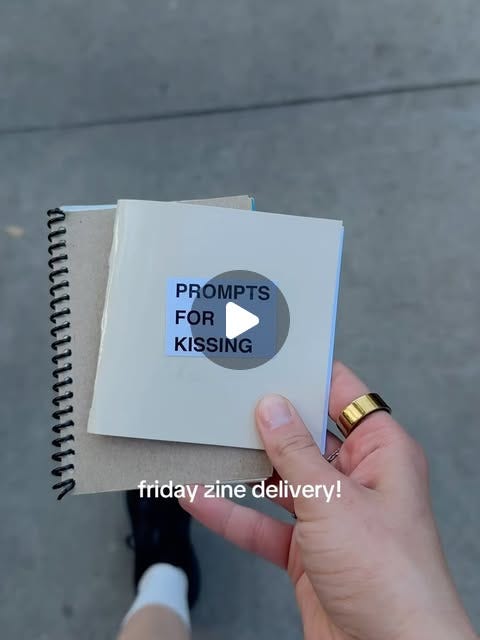
I have a new zine! You can buy a print copy on my website.
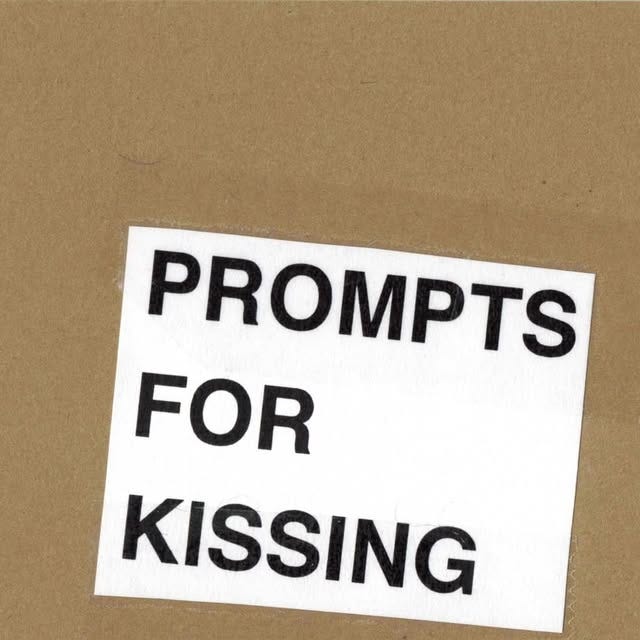
Or, if you live in LA, I’ve been leaving free copies in free little libraries all around town.
Current obsessions:
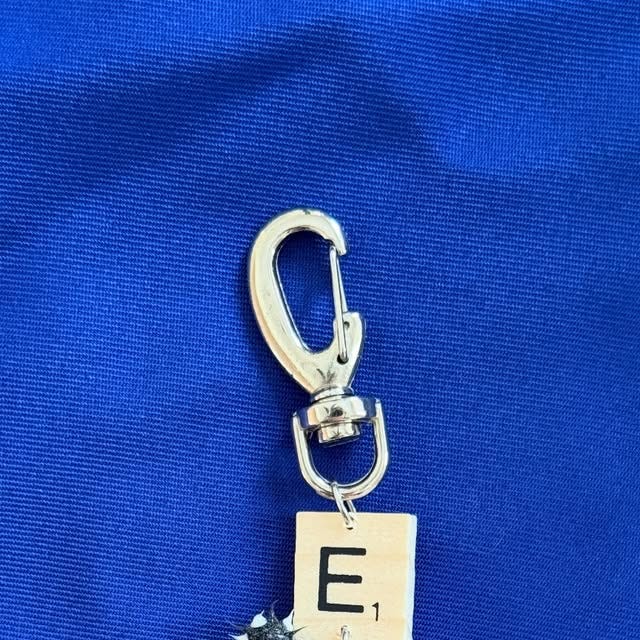
Making keychains / bag charms:
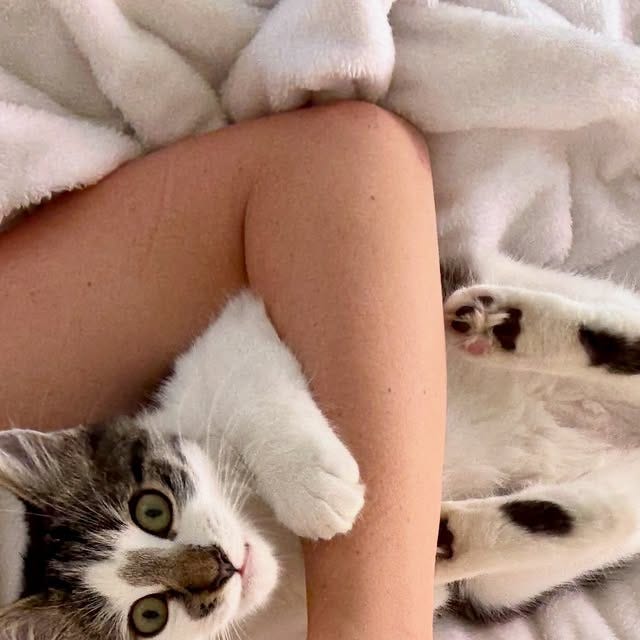
My cat:
This song:
What I’m reading:
8 effects of dietary restriction impacting all body shapes and sizes
Tonight I’m Someone Else, Chelsea Hodson
I’ll Drown My Book: Conceptual Writing by Women
Quotations:
Every kind of art that I’ve enjoyed seeing, it gives me a feeling of being happy to be alive. If I see a movie or a band that’s a surprise, I think, “I’m so happy to be alive.” That’s kind of my approach to making things because that’s the feeling I want everyone else to have.
Do you think about the audience when you’re making stuff in general?
Not really. I think of my friends. Will Bill Hader like it? Will Andy Samberg or Tina Fey like it? It’s more for them. I think that’s as far as I go. Or I think of my musician friends. But it’s always my friends.
Some people do force themselves and they come out with gold. I know people who are like, “My writing time is from this time to that time,” and boy are they prolific. I think more in terms of, “Something will arrive at my brain. And if not, so what?”
I have this theory: you can’t write books without living. I’ve talked to a few writers who say they find inspiration in their own head, in other books, in history, on Wikipedia, and that unfortunately due to their deadlines they don’t have time for much else in their life besides reading and writing. Now, I’m sure this works for them (some of them are bestselling authors, so…clearly it’s working), but I personally cannot fathom living like that. I have so many interests oblique to books, and they’ve shaped my writing—because they shape who I am as a person.
It’s a real drag, being someone who believes very strongly in the equal rights, value, and dignity of gay life and gay love in a period where gay culture amounts to a bunch of Disney Adults peppering their online presence with 24-hyphen font declarations of their various orientations and identities but who otherwise seem offended by the fact that human beings live in fleshy corporeal hormone-laden bodies. I was reading Reddit at some point awhile back and somebody said “I basically define my sexual orientation as Steven Universe,” and I thought to myself, brother, I believe you. And honestly, god bless. God bless those for whom one’s sexual preference is a statement of sexlessness. You’d just prefer, you know, if that wasn’t the dominant voice in the culture. The internet was supposed to let a thousand subcultures bloom, and bloom they have, in much the same way that algae blooms in a beautiful lake and kills all the fish. As ugly and bigoted as right-wing identity politics are, its advocates have always had this point correct: that when you valorize marginality as such, then you end up with the people who are the most vocal about being marginal making the law. Not the most marginal, but rather the ones who talk the most about marginality. And in LGBTQ culture, that’s meant that the most juvenile Funko Pop collectors within the coalition have colonized the entire cultural space. Hope you like Dr. Who!
If you’re a gay celebrity and a lot of straight women refer to you as their “gay boyfriend,” it’s not a compliment. No doubt that’s a profitable place to be, but it’s still not a compliment.
“The modern gay rights movement and increasing social acceptance of LGBTQ people have come at the cost of deradicalizing that movement and rendering gay culture sexless and unthreatening” is an old argument; I was probably making it 15 years ago. And, yes, it’s true - something was lost when people began to think of Bert and Ernie as queer icons, when the assertion of gay rights became inherently an assertion of gay harmlessness.
Gay culture has been bifurcated into these two weird extreme tendencies, between Hallmark Channel Ken doll genital-free innocuousness and meat-market desensitization. These are, of course, two equally dehumanizing visions. On one hand you have the mass-market version, the network-sitcom vision of gay men as harmless stuffed animals, affectless, impotent little cuddle objects whose entire emotional landscape revolves around brunch and “yaaaas queen” culture, the kind of neutered mascots straight audiences can love because there’s nothing there to threaten them. And on the other end you have the joyless sexual exhaustion of what passes for “liberation” in certain corners, an endless circuit of meaningless hookups, pharmacological numbing, and pornified compulsions that are somehow treated as radical even though everyone involved looks miserable. The middle - the space where sex is allowed to be joyful, where cultural production is allowed to be vital, where being gay is not a marketing demographic or a pathology - is barely legible in public understanding of gay culture. And that absence tells you everything about what this country demands from its minorities: be cute and safe for us, or destroy yourself quietly out of sight. That some within gay culture seem to enthusiastically play to this binary makes it more depressing.
I’m a fan of depravity, philosophically. I’m not much of a pervert, but I support perversion as a concept.
I’m afraid that eroticism, like romance and seduction, cannot exist without risk. Those virtues cannot exist without uncertainty. And what the modern perspective on sex and love insists on is that uncertainty is indistinguishable from danger, from physical danger. The Zoomers believe that it’s deeply immoral to approach a stranger on the street and ask them out, among other scary stories; that they are also the loneliest, most unsatisfied generation one can imagine has been pointed out by many people, many times. The point is not ultimately that the street is some sort of sacred space, nor even that the act of asking someone out must be an aggressive one, but that not knowing the outcome of an exchange in advance is an unfathomable, unbearable conundrum to them. That, ultimately, is the source of this fear, this all-pervading, all-conquering fear that the 20-somethings have inculcated in the world of human sexual and romantic relations: the idea that they might engage in an interaction with another human being without knowing what that person wants and doesn’t, or even worse, without fully knowing what they themselves want, and must thus confront an unknowable, chancy, risky immediate future.
To enjoy the things that are most enjoyable in life you must risk the experiences that are the most painfully awkward and embarrassing.
I love the way you rub
the red lipstick off above my Cupid’s bow—
how you call it the halo of my face, because
girliness equals goodness equals godliness.
-Dorothy Chan
I grow
defenseless against desire—I almost touch
myself remembering your scent, time zones away.
-Aria Aber, “Gardens of Babur, Kabul”
I gathered secrets like little pieces of survival.
-Chelsea Hodson
I liked the inevitability of nature, the violence required for Earth to endure.
-Chelsea Hodson
I wanted to delay the ending. Just one more minute.
-Chelsea Hodson
When it got so bad, I thought about how. How I could with the oven. How I had my own personal bath.
-Stevie Belchak, “Drawing in Me Something Explicit”
The day she arrived, my mother and I walked to the farmer’s market. I pretended to feel good, to feel happy—that is, that I felt. Among the golding squash and Brussels sprouts bellying their green, I pretended my mouth was more than a shape, my body—more than a clothes hanger for skin.
-Stevie Belchak, “Drawing in Me Something Explicit”
Let me tell you something about Georgia. Most everyone is repressed, not just homosexuals.
-Catherine Pond, “My Lesbian Diary”
My head was a glove. It had many fingers. It grabbed for things, but they were slippery. I couldn’t find the light switches, and I forgot how to make food, so I ate cheese slices in the dark. No, it wasn’t that bad. I ate cheese slices in the moonlight. I had had a stroke. I guess I have to keep saying that. It is the context and the lens.
-Richard Siken, “On Perplexity: Chrysanthemum”
It is easy to talk about terror, and awe has its own vernacular: divine, reverent, wondrous, uncanny. But terror and awe are nouns, and perplexed is an adjective. To be confused is to be in a state of confusion. To be perplexed is to be in a state of what? Perplexion? It sounds made up, but I suppose all words are made up. What is a light switch? Where are light switches, and what do they do? I looked at the light switch. Sometimes I knew what it was. I flipped the switch, up and down. It tickled me.
-Richard Siken, “On Perplexity: Chrysanthemum”
The world is vast and strange. It is a difficult thing to dwell on. Sometimes things are larger or smaller than they should be. That makes me anxious, which is the same thing as excited, though we call them different things depending on our levels of safety and optimism. Maybe. I am still afraid of falling in the shower.
-Richard Siken, “On Perplexity: Chrysanthemum”
When faced with the unknown, people can make their best guesses and get it wrong, over and over, and call it science.
-Richard Siken, “On Perplexity: Chrysanthemum”
Before my stroke, I wasn’t a fan of the paragraph. I wrote in lines. The paragraph seemed so plodding and obvious and, well, connected. There wasn’t room for mystery because there weren’t gaps for the mystery to get into, much in the way that it’s difficult to set a poem to music because a poem is already music, so there’s little room to add more music to it. Now I respect the paragraph though I’m not sure I like it. I am trying to learn it. To me, it is now crucial though still not exciting. Maybe a little exciting. It’s hard to work in a box. For me it is.
-Richard Siken, “On Perplexity: Chrysanthemum”
I don’t think trauma makes for better art, but I think perplexity is fundamental to it.
-Richard Siken, “On Perplexity: Chrysanthemum”
Conceptual writing often involves a recasting of the familiar and the found.
-Laynie Browne, I’ll Drown My Book: Conceptual Writing by Women
This writing does not attempt to create neatly drawn solutions, commentary or speakers, but rather to experiment not for the sake of experimentation but with the desire to reveal something previously obscured.
-Laynie Browne, I’ll Drown My Book: Conceptual Writing by Women
I was unspeakable so I ran into the language of others.
-Kathy Acker
And thus, she lit the temperature of my mouth.
And thus, she lit my breast subtle with light.
-Oana Avasilichioaei and Erin Moure, “The Lettuce Smeller”
Translation, which is always writing, is impossible because there are no equivalences, only counterparts and digressions, and necessary because there are no equivalences, only counterparts and digressions.
-Oana Avasilichioaei and Erin Moure, I’ll Drown My Book: Conceptual Writing by Women
nothing bodies more beautifully than instinct
-Angela Carr, “Of Running, Of the Core”
how the smell embodies me
bodies and the smell of you running
i say bodies when i mean to say running
-Angela Carr, “Of Running, Of the Core”
—Define yourself.
—A catalogue of failures.
-Monica de la Torre, “Table No. 35”
To have a language is to make a pact with every other user of that language that you will, for the most part, employ its vocabulary in the agreed upon fashion.
-Renee Gladman, “Emergence of a Fiction”
What excites me is this: there is a feeling I want to communicate with you. It is already at one remove because I have taken it out of its originary space—my mind—and brought it into the open. After this briefest of moments in the open, a second remove is introduced. I have to lay the feeling over a string of words that, though they represent to some degree what I want to express, are not the feeling exactly. The words I choose have their own associations, calling to my sentence meanings and textures I did not intend. And what tops off this incredible drama of just the first sentence of this provisional text about a seemingly long ago feeling, is that the very structure of the English language (or at least the way in which we are taught to practice it) requires that I express my feeling as if it were a coherent, linear story. That is, I begin with a subject, put it in action (or a negation of action), and round it off with some significant consequence.
-Renee Gladman, “Emergence of a Fiction”
What happened last night? A whirlwind of things. I remember teeth, a flushed feeling, and cheeks suffused with moonlight.
-Sharon Mesmer, “Revenge”
What I want. What I want now. What I want to devour.
-Sharon Mesmer, “Revenge”
4. I am preoccupied.
5. Night falls.
-Deborah Richards, “It’s a Jungle Out There”
I got used to the spitting. But I did not get used to having the body that got spit upon. My mind would think something like my body is once again my body. But my body was not really agreeing with this because it felt even less like it was mine.
-Juliana Spahr, “The Remedy”
I wanted to flatten the pastoral, and extract its classicism.
-Marcella Durand
I also like—no, love—when the text opens for an action beyond the space of the text. A possible action.
-Mette Moestrup
What is interesting about conceptual writing is its ability to disrespect the grammar of habitual communication, to operate beyond logics, and to ignore the strict definition of language as well as the constraints and requirements that other, ‘more serious’ writing genres are confined to. The different methods conceptual writers use can oblige certain rules, but conceptual writing in itself will be difficult to define according to such. It is not limited by the constraints of one single genre, but operates freely on the borders of many disciplines, and some pieces of conceptual writing can indeed be closer to pieces of visual, sound, or performing art. There is something very liberating to language operating beyond its commonly accepted functions; you could call it linguistic anarchy, and although this aspect is not a goal in itself, it is certainly essential to conceptual writing.
-Cia Rinne, “On Conceptual Writing”
How do I compose/re-compose a body that’s pure sensation?
-Bhanu Kapil
Animality is not a remnant left to us.
-Chus Pato
I tried the impossible, to write from the animal. But it can’t be transmitted: the roar, the howl of the mammal that I am.
-Chus Pato
If we are anything, it’s body. You learn it when you age and are more conscious of death. And language is the shuddering of that body.
-Chus Pato
lately you say I’ve had an awkward
pull
toward the past tense
-Rosmarie Waldrop, “Kind Regards”
Kathy Acker and Cindy Sherman taught me that the self in writing is always a performance.
-Dodie Bellamy
I do not believe the conceptual—especially in the work of women—can be separated from the body.
-Dodie Bellamy
Whenever I meet new people I want to touch them first and find out their texture.
-Sawoko Nakayasu, “Texture Notes”
My writing: hard-boiled. My life: scrambled soft.
-Vera Pavlova, “Heaven Is Not Verbose: A Notebook”